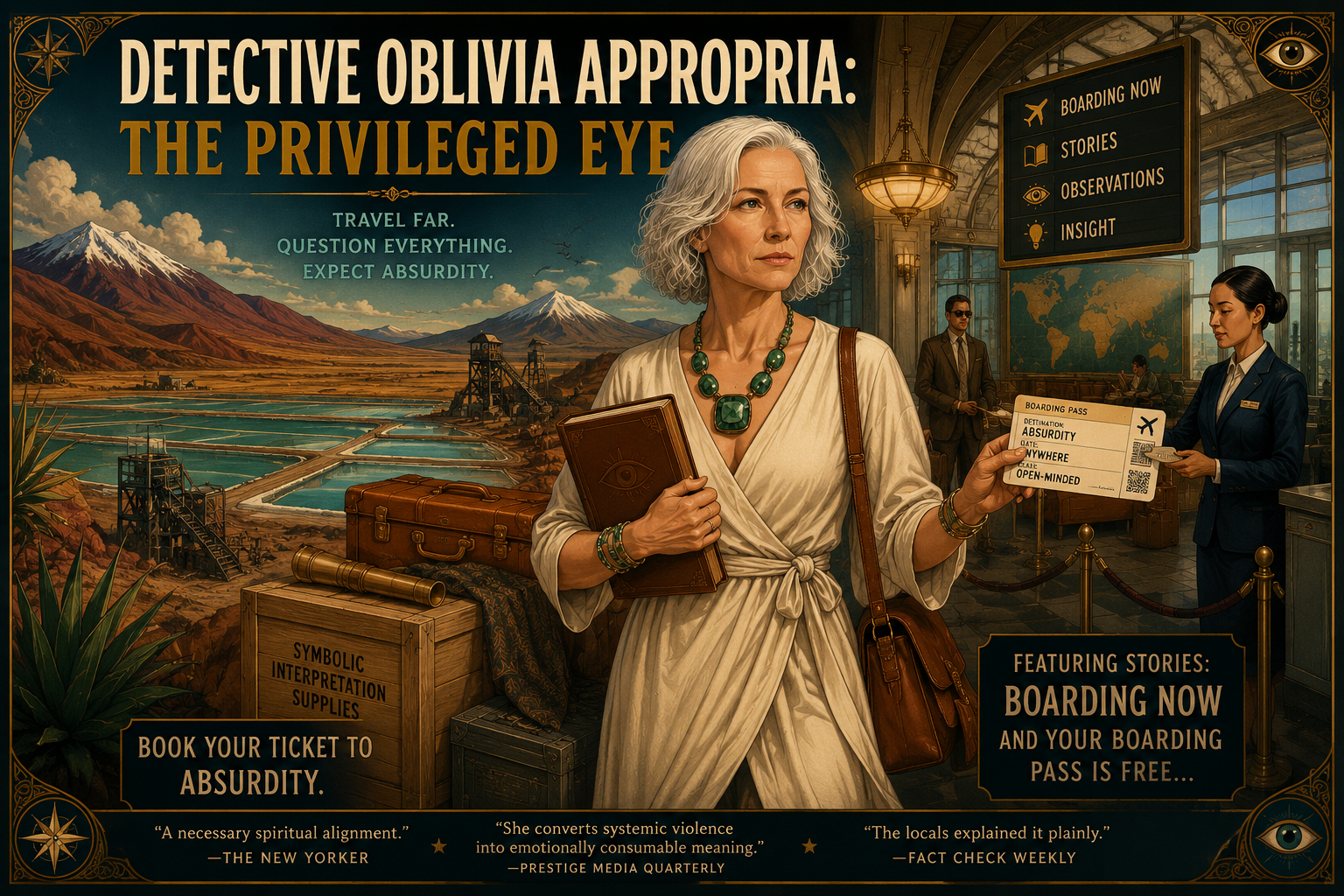



The name does all the heavy lifting.
Oblivia: oblivious.
Appropria: she appropriates.
Together they name a particular contemporary figure with surgical precision — the wealthy, well-intentioned Western woman who moves through the world armed with the correct politics, the right reading list, and an unshakable belief in her own perception. She arrives sincerely. She listens deeply. She leaves having taken something.
This is not a satire of villains. Oblivia means well. That is the entire point.
In each story, she travels to a site of real consequence — a contested dam project in the Rift Valley, a corporate wellness retreat built over a compromised cenote, a rewilding scheme, a grief ritual. In each, she “solves” the mystery. And in each, her solution is elegant, photogenic, and fundamentally wrong. The actual cost is borne by those who will never appear in her author photo.
Accompanying her is Alexandrei Harris, the respected environmental journalist whose dispatches lend institutional weight to what she believes she has witnessed. Between Oblivia’s intuitive certainty and Alexandrei’s polished prose, a closed circuit of knowing is formed — one that feels authoritative precisely because it is self-reinforcing.
Beneath them both are the people who actually live there. They explain the situation clearly from the beginning. They are rarely heard, almost never credited, and never allowed to complicate the story Oblivia needs to tell.