LISTED
Added to the National Priorities List in 1990, in response to the nature
and extent of PCB contamination.1
a wound receives its file number
The mills made paper that copied without carbon. The copying required a molecule that does not die. This ledger records where the molecule went, what was paid, and what the water still carries. You are reading it from below the outfall. Everyone is.
OPEN THE LEDGERBetween the 1950s and 1971, mills on Portage Creek and the Kalamazoo River de‑inked and recycled carbonless copy paper — NCR paper, the kind that duplicated a signature without a sheet of carbon between. The duplicating coating was made with polychlorinated biphenyls. De‑inking freed them.1 The paper copied documents. The process copied harm, in a chemically persistent form, into the sediments of a river system that drains to Lake Michigan. What follows is the official account, entered as received. Read the margins.
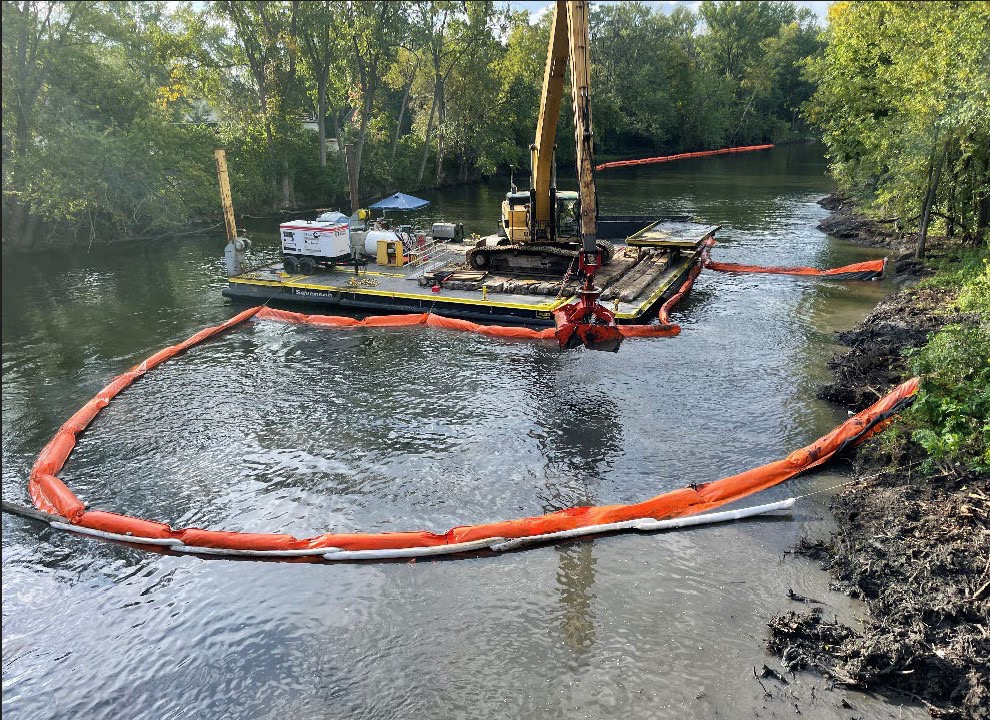
The site is not a point on a map; it is the map. Below, the river runs west — Morrow Dam on the right, Lake Michigan on the left, Portage Creek arriving from the south through the city. Each stain is an operable unit. Open them. Then raise the water and watch what contained does under load.
PCBs are lipophilic: they prefer fat to water. So the river files them in living tissue — algae, then insect, then minnow, then carp, then whatever eats the carp — each step up the chain a concentration, an interest payment. The fish are the river’s memory in edible form. The State of Michigan publishes, every year, a guide to how much of that memory a body can safely absorb.7
Three sliders, one receipt. This instrument computes nothing about your body; it computes your position in the ledger. The disclaimer at the bottom is the most factual line on it.
A cleanup this size runs on paper — fitting, for a paper town. The paper runs on terms of art, and the terms of art do double duty: each one describes a procedure and performs a reassurance. The fronts of these cards carry the official senses, paraphrased from the record. The reverse faces are editorial — this project’s unhoused glosses, what the term says when it is not at work. Flip them.
Paste a phrase of remedial prose. Indexed terms will be unhoused.
Depositions were taken. Not all of the deponents are persons; none of them are quotations. The two human voices are composites, invented for this ledger — no real person is quoted or portrayed. The others are readings of the record, given voice. That is what an oracle has always been: the file, speaking.
Decisions leak forward. A coating formulated in 1954 becomes a line in a 2025 fishing guide; a bankruptcy docketed in 2009 becomes the funding condition of a cap poured in 2024. The timeline below is drawn with its echoes attached — select an entry and see where it lands. Entries marked projection are exactly that.
The remedy is protective of human health and the environment in the short term. Long‑term protectiveness requires the continued operation and maintenance of engineered controls and the enforcement of institutional controls, to be verified at intervals of five years, for as long as contamination remains in place.
for as long as contamination remains in place — that is: there is no last five-year review on the schedule. maintenance is the remedy. the remedy is a subscription.
The contamination is not on this land; it is a stratum of it. The Superfund is not an erasure but a newer myth laid over an older one — the devouring mill, then the managing agency — and both are load‑bearing now. The debt was never denominated in a currency the river accepts, so the payments continue in the only coin available: attention, in perpetuity. Meaning is produced. So is its sediment. You are downstream. Everyone is.
Kept in your browser only (localStorage); nothing is transmitted. Log what you noticed. Export it before the container of your attention is reclaimed.