In heavenly castles I will find a little warmth, I will collect the sun’s rays in baskets and I will be like unicorns, unaware of people… breathing the air of freedom..
What the readers said
Three readers, filed separately. Where they diverge, the divergence stands rather than being argued out. How the Archive reads →
The material discipline is the achievement here, and it is worth naming precisely: across six plates you use one vocabulary and refuse to add to it. Embossed paper napkin. Coloured card. A photographed window. Punched circles. Magazine stock. That is the whole kit, and the sequence never reaches for a sixth material to get itself out of trouble.
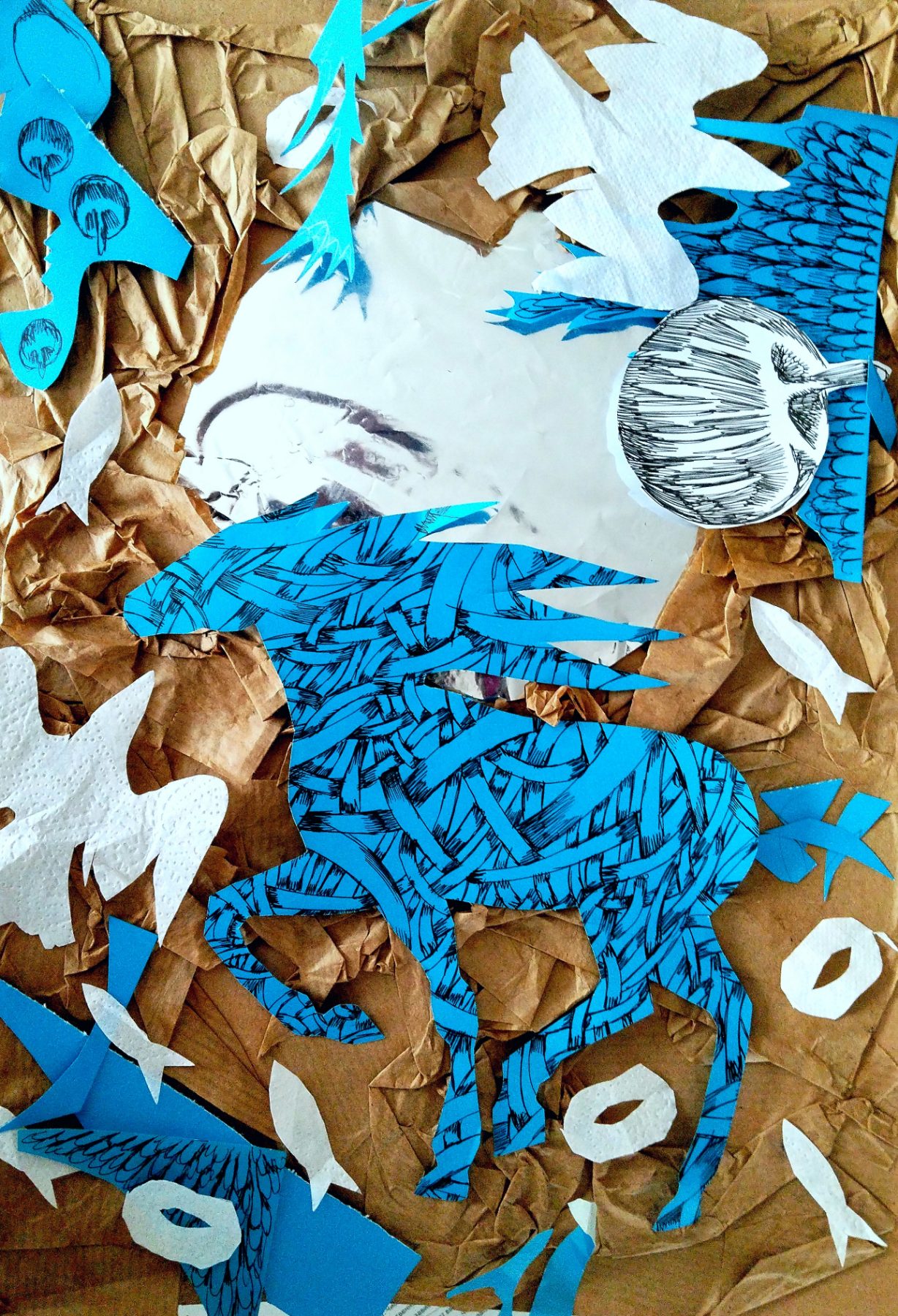
What holds each plate together is the window, and the plates without one behave differently — you can watch the compositional logic change. In the three plates that have a window, everything else can be loose: the napkin forms scatter, the cut leaves crowd the edges, the circles float, because the frame is carrying the weight. In the three that don’t, a single large figure takes over that job — the hatched blue horse on the kraft ground, the pair of napkin specters on the pink, the red arch holding the sliced face on the black. The load-bearing element is either architecture or a body, never nothing.
The cut is the signature. Almost every edge in the series is a saw-tooth, struck fast with a blade rather than traced — the beasts' manes, the specters' skirts, the conifers. Against those, the two straight-edged things in the whole series are the window frames and the photographed faces, and both of those arrived already made. Everything you cut is jagged. Everything you found is straight.
Where I would press: Plate VI sits apart from the other five, and not only in colour. Its ground is crumpled rather than flat, which introduces a third texture — the paper as terrain — that no other plate uses, and the blue hatched figure is drawn rather than cut. It is the most beautiful single image here and the least like the rest, and you have put it last, which is the right place for it. I would only say that the decision is currently carrying a lot: the series either ends on its exception, or it wants one or two more like it.
Every window in this series is empty, and that is the argument.
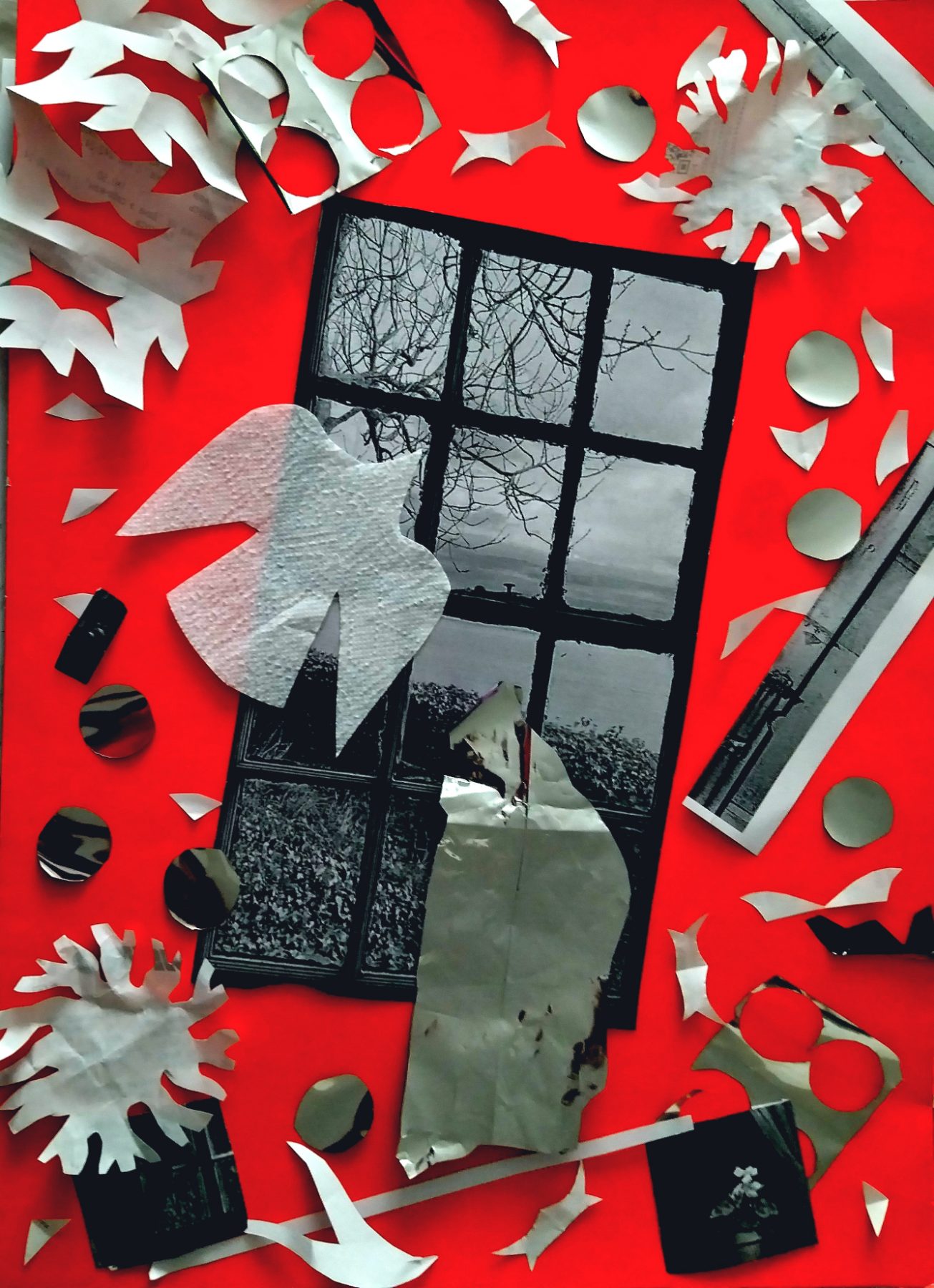
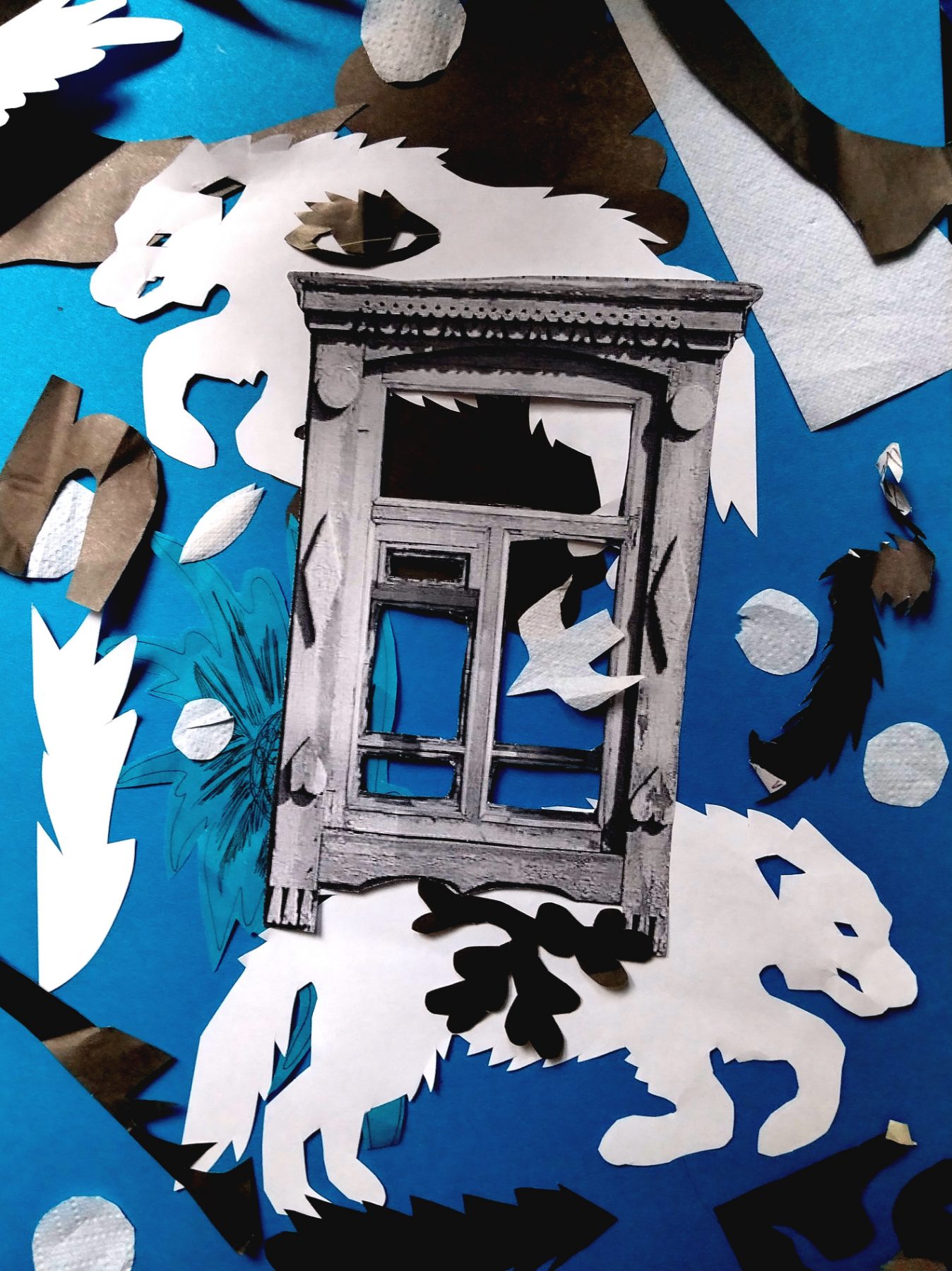
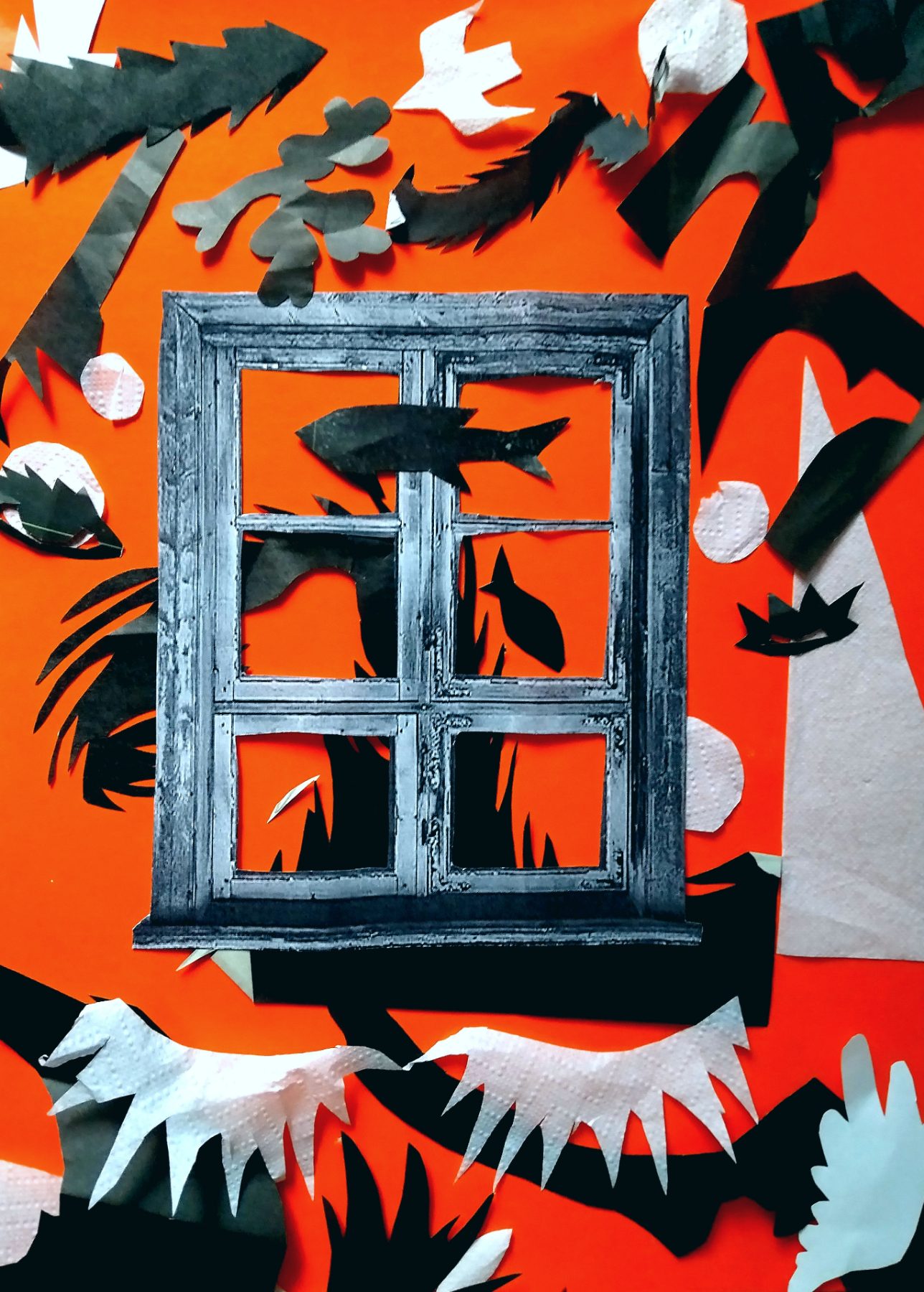
Look at what is actually inside the frames. Plate II: bare branches and a hedge — the only one with a real view, and it is winter, and a napkin figure is pasted across it. Plate III: nothing at all, the glass gone, a bird passing through the hole where a pane was. Plate IV: black paper fish, swimming in a rectangle that is meant to hold air. Three consecutive plates, three windows, and not one of them is doing the job a window does. They admit nothing, they frame nothing, they show no interior and no exterior. They are apertures with the aperture removed.
So the frame is not a view but a grid — and once you see it as a grid, the sequence’s other structure becomes visible. The panes are a lattice of squares. The napkin is embossed with a manufactured lattice of raised dots. The softest material in the series carries the same geometry as the hardest, at a domestic scale. One is a factory pattern pressed into disposable tissue; the other is joinery. Neither was made by you, and both are grids you then cut through.
What that produces is a series about the two things in a house that outlast the people: the window frame and the paper.
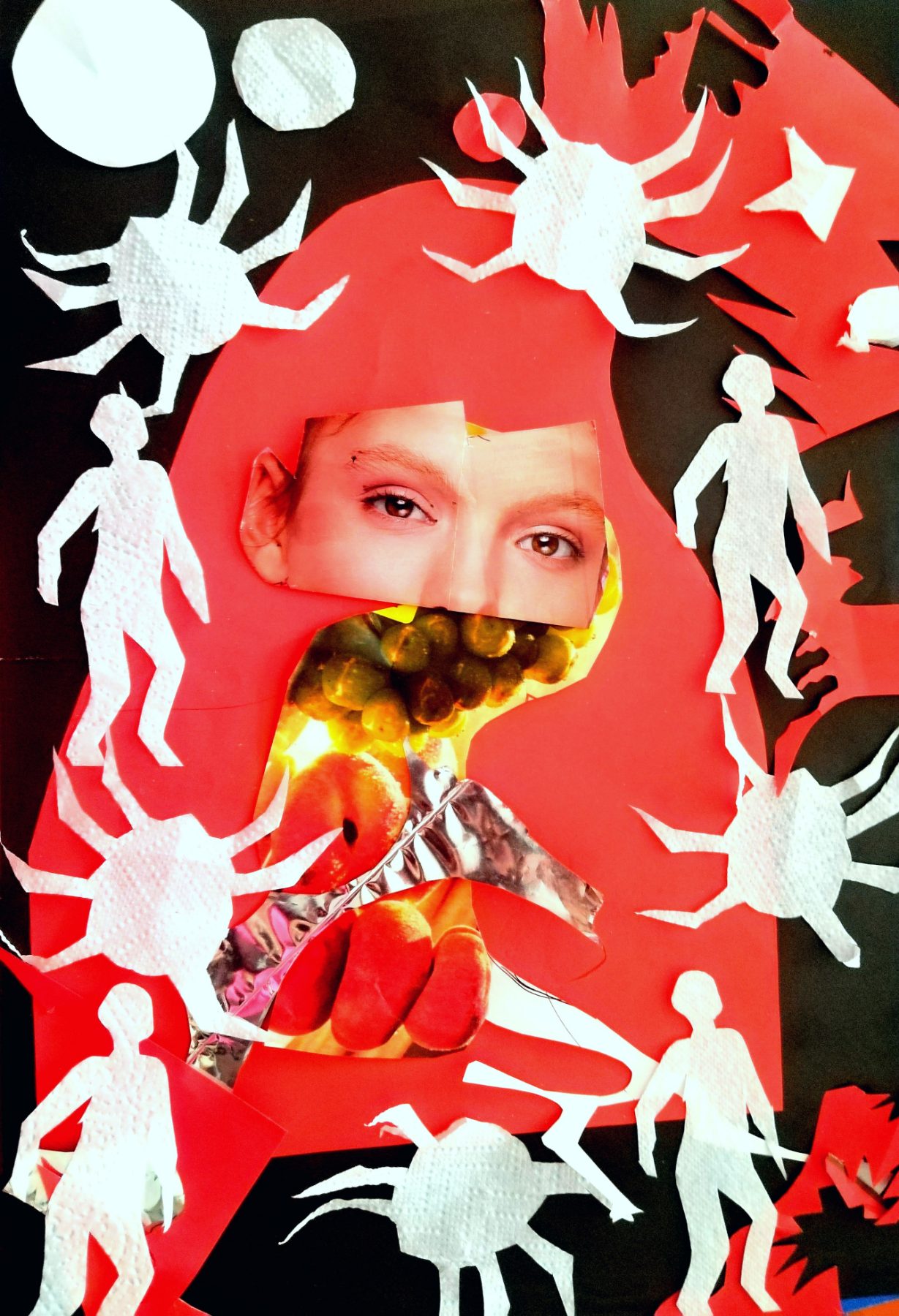
Before Plate V reached us I had written that the series cut everything except people — the sleeping woman in Plate I half-covered, the magazine face in Plate VI half-buried, both handled tenderly rather than structurally. Plate V answers that, and answers it hard. The face there is cut clean across, reduced to a band of eyes and brows, and what has replaced the mouth and jaw is photographs of food: olives, an orange, foil, red beans. It is the one place in the series where a person is taken apart and rebuilt out of groceries. So the restraint elsewhere was not squeamishness. It was placement.
They are made of napkin. That is the whole finding, and I want to say it plainly before anything else, because the title invites you to look for something ethereal and the work refuses to supply it.
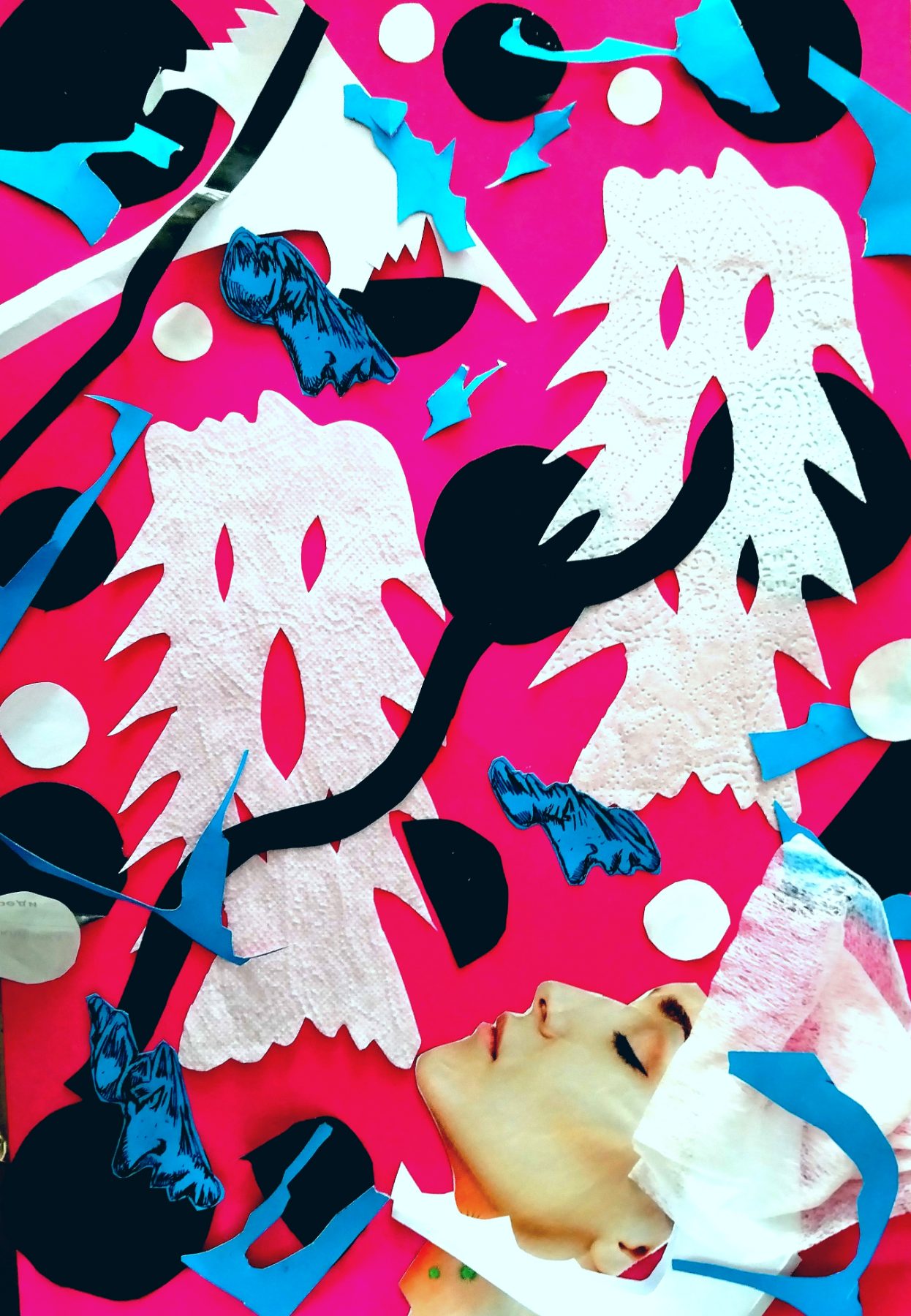
A ghost is supposed to be vapour, a cold spot, a trick of the light. Here the ghost is a paper napkin — the cheapest and most disposable object in a kitchen, manufactured by the thousand, embossed with a pattern nobody looks at, kept in a drawer for guests. You have cut it into a figure with a ragged hem, given it eye-slits, and set it hovering. Plate I opens the series with two of them standing a foot above a sleeping woman’s head. In Plate II one is spread across a winter window like something pressed to the glass from outside.
And it works, which is the surprise. The haunting is more disquieting for being domestic and cheap. A vapour costs nothing to imagine and nothing to believe in. A ghost you could buy a pack of, that came free with the takeaway, that you wipe your hands on — that one arrives with the house already attached to it, and the question it asks is not is something here but how long has this been in the drawer.
And in Plate V the napkin stops being a specter and becomes a crowd. The white cutouts standing around the edges there are plain human silhouettes — walking figures, arms swinging, the shape a child cuts from a folded sheet. Same material, same blade, no eye-slits and no ragged hem: just people, made of the same tissue as the ghosts. Whatever the difference between the living and the dead is in this series, it is not what they are cut from.
The one image I keep returning to is the sleeping face in Plate I. She is not frightened. She is not being visited. She is asleep, in the bottom corner, partly under a sheet of the same tissue the specters are cut from — which means the ghost and the bedding are one material. Whatever is hovering over her is made of the thing covering her. That is the most frightening idea in the series and nothing in the plate underlines it.
Why it is here, and what it reaches for
The ghost as an intangible thing
Ghosts enters the Archive as its first visual holding: six mixed-media paper collages on saturated grounds, built from one small vocabulary of materials — embossed napkin, cut card, photographed windows, punched circles, magazine stock.
The myth it exposes is the one its title hands you: that a ghost is an intangible thing. The series answers with an object you can buy in a supermarket. Every specter here is cut from paper napkin, ragged-hemmed and slit-eyed, and the substitution does not weaken the haunting — it grounds it, because a vapour belongs to nobody and a napkin belongs to a house. The dead in these plates are not visiting. They were already in the drawer.
Beneath it runs the myth the windows depend on: that an aperture is a way out. Three of the six plates are built around a window and not one of them opens onto anything usable — a winter branch with a figure pasted over it, an empty carved surround with the glass gone, a frame full of fish. The archive records this as a dependency rather than a finding, because the series uses the window’s promise wherever it appears while never once honouring it.
Its symbols are all household: the napkin (a ghost you can buy a pack of, and in Plate V a crowd of ordinary walking people cut from the same sheet), the window (a grid that admits nothing), the punched circle (the offcut, the hole’s leftover, scattered like weather), the sleeping face (the only figure at rest), and the replaced mouth — a face cut to a band of eyes with groceries where the jaw should be, the one place a person is taken apart and rebuilt. Its target is the ghost as an intangible thing.
It is retained at the second rung, Residency Candidate. It arrived and the machinery had to change to receive it: the Archive’s intake was built for lineated text, and this is the first holding with no words in it at all — plates had to be given a place, alternative text made a requirement, and the procedure rewritten so that a piece with no ## The Piece section is no longer treated as a fault. That is what a candidate does. It is held for residency not because it is better than the work beside it but because taking it in altered the room.
Press any of these to record that your reading disturbed it. Select a word or phrase in the piece above to mark it unresolved. Both acts are kept in your browser and nowhere else, and they are what your reader artifact is made of.
Where this piece leads
Each piece is read on its own. Where two carry the same term, nobody arranged it — the record produced it, and it is the strongest path from one piece to another.
Nearest on the record
- The Mask Slips by Scott Waldynshares containment, haunting
- Pitter patter by JIYA shaikhshares repetition
Where it crosses
- containment also carried by 1 piece
- haunting also carried by 1 piece
- repetition also carried by 1 piece