Issue I · Inaugural
Issue I · Inaugural
The Submission Fetish
Vol. 1 / Fall 2026
The first gathering of the record: 31 offerings from 28 voices, each published in full and read in the open. What follows is the issue.
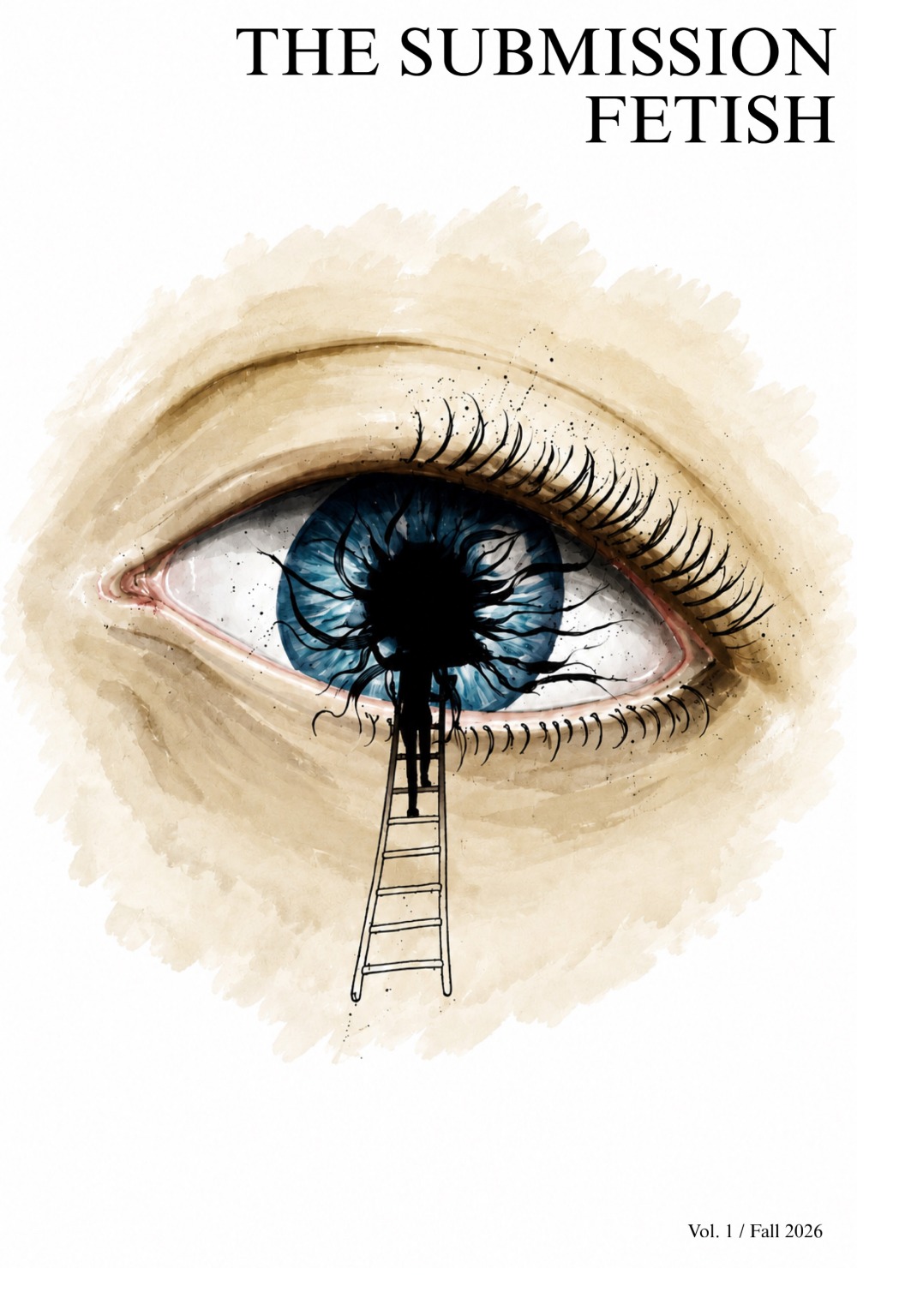
Cover art by Victoria Mansberger Schoen
35 · Poetry
Pretty if thin
Residency Candidate
34 · Poetry
Three Attempts At Being Here
Residency Candidate
33 · Fiction
The Mask Slips
In the Archive
32 · Poetry
Constitutional
In the Archive
31 · Fiction
This Is Not a Drill
In the Archive
28 · Poetry
Each of us carry different identities
In the Archive
27 · Poetry
Pitter patter
In the Archive
26 · Collage
Ghosts
Residency Candidate
24 · Creative Nonfiction
Back in Black
In the Archive
23 · Poetry
Ode to a Grandmother
In the Archive
22 · Fiction
SIXTEEN MURDERERS
In the Archive
20 · Poetry
Riverine
In the Archive
19 · Prose Poem
Revelation 3: 20
In the Archive
18 · Poetry
The real maniac (“The blood will spill”)
In the Archive
17 · Poetry
Crackpot
In the Archive
16 · Poetry
Transmigration
In the Archive
15 · Prose Poem
Confessions of a Renegade Chef
In the Archive
14 · Poetry
Accidents Do Happen
In the Archive
13 · Poetry
Woman in a Twist
In the Archive
12 · Poetry
I Remember That Fire
In the Archive
11 · Poetry
A Shackled Liberty
In the Archive
10 · Poetry
Lifeline
In the Archive
09 · Prose Poem
My Booyah Moon
after Lisey’s Story, by Stephen King
In the Archive
08 · Poetry
Knowing A Language
In the Archive
07 · Poetry
A Blue Moon Spell & The Lodestone of Love
In the Archive
06 · Poetry
Three Poems
In the Archive
05 · Poetry
The constant degradation
In the Archive
04 · Poetry
Admire the Creator in His Creatures
Lazarus Colloredo, Paris, c. 1638.
Residency Candidate
03 · Poetry
The Piece Entrusted to Me
In the Archive
02 · Prose Poem · Foundational Myth
Instructions for the Gate
Systemic Code
01 · Essay
The Glass Ledger
In the Archive
After reading
Other ways into the record
Issues surface quarterly — the dates are on the Release Calendar. The Submission Fetish is where the work comes in.
The Constellation — a spatial map & indexes →
The Concordance — every myth, symbol & theme →
The Forms — the holdings by what they are made as →
The Descent — fall through the record →
Your Reading — what your path has produced →
The Residency — the pieces that went further →
How the Archive works →